
Pressure injury cases are built in the timeline, not by the wound’s stage alone. The key questions are when the facility recognized risk or skin changes, what it did in response, and whether staff followed through.
The defense may call the injury unavoidable. Your first review should test that claim against the chart. Did the facility identify the resident’s risks? Put an individualized plan in place? Carry it out, monitor the results, and change course when the condition worsened?
A pressure injury, by itself, does not prove negligence. But records can reveal a preventable sequence: risk recognized, intervention ordered, care missed or inconsistently documented, wound deterioration, and delayed escalation. A legal nurse consultant can help you find that sequence early. Before the defense defines the story for you.
Start with the clinical timeline, not the final wound
Build the timeline from admission through discharge, transfer, or death. Establish the resident’s baseline skin condition and mobility, then track each subsequent assessment and change.
Look for:
- Admission and ongoing skin assessments, including the location and description of any existing injury.
- Risk factors such as limited mobility, incontinence, nutritional concerns, impaired sensation, or relevant comorbidities.
- The date staff first noted redness, discoloration, an open area, pain, or another skin change.
- The timing of wound measurements, treatment orders, consultations, and provider notifications.
- Whether the wound improved, remained unchanged, or deteriorated, and what the facility did next.
The timeline should reconcile multiple records, not rely on one nursing note. Compare skin assessments with wound-care notes, treatment administration records, care plans, orders, nutrition documentation, therapy notes, and transfer records. A gap between what the plan requires and what the record shows is a lead to investigate, not a conclusion by itself.

Follow the care plan from assessment to bedside
A care plan only matters if it addresses the resident’s needs and staff implement it. Check whether interventions match the risk assessment and the resident’s circumstances. Depending on the clinical picture, records may address repositioning, off-loading, support surfaces, moisture management, nutrition, wound treatment, and monitoring.
Then test the plan against the daily record:
- Are interventions individualized, or do entries look generic?
- Do turning or repositioning records reflect the plan?
- Do treatment records show what was applied and when?
- Is there documentation of refusals, tolerance, and follow-up?
- Did staff notify the provider or wound-care clinician when the injury changed?
- Was the plan reassessed and revised when the resident’s condition or response called for it?
CMS’s Pressure Ulcer Critical Element Pathway guides surveyors to examine assessment, care planning, provision of services, reassessment, and prevention or healing. The federal framework is useful context, but a regulatory finding does not automatically resolve the legal standard in a particular case. Evaluate the facts under the applicable law and expert opinions.
Read wound descriptions for substance and consistency
A stage label is not a wound assessment. Look for objective details: precise location, dimensions, wound-bed and surrounding-tissue descriptions, drainage, pain, and signs of complications. Determine whether the documentation explains the clinical basis for the classification and tracks change over time.
Compare entries across shifts and disciplines. Are measurements repeated exactly despite apparent deterioration? Does the stated stage align with the description? Does the chart identify an injury in one record but omit it from the care plan? Inconsistencies warrant closer review and targeted discovery.
Also check whether the lesion was correctly characterized. Not every area of skin breakdown is a pressure injury; moisture-associated skin damage and other conditions can be confused with pressure-related injury. The NPIAP staging resource can help orient your review, but clinical classification and standard-of-care opinions belong with qualified experts.
Challenge “unavoidable” with the resident-specific record
“Unavoidable” is a clinical claim that needs support. Advanced age, immobility, incontinence, or other health conditions do not answer whether the facility assessed the resident, implemented appropriate measures, monitored results, and responded to changes.
Ask what the facility knew and when. Did a change in skin condition trigger a reassessment? Did staff document the measures taken and why they were appropriate for this resident? If an intervention was refused or could not be completed, is that documented with a meaningful response or an alternative plan? If the injury progressed, did the facility explain why and escalate care?
Avoid treating missing documentation as automatic proof that care was not provided. Instead, identify the specific record gap, determine what documentation the facility’s own process called for, and compare the account with other evidence. For more on this approach, see how to identify what the nursing notes leave out.

Find the records that complete the picture
Early case assessment should identify what is missing, not just summarize what has arrived. Depending on the case, consider requesting:
- Complete wound assessments, photographs if maintained, and wound-care consultant records.
- Care plans and revisions, treatment administration records, and repositioning documentation.
- Skin surveillance, nutrition and hydration assessments, relevant laboratory results, and orders.
- Provider notifications, family or representative communications, and refusal documentation.
- Facility policies, staffing records, and relevant electronic record audit information.
The purpose is to test the timeline and care process, not to assume that every missing item proves a breach. A focused request tied to a clinical question is more useful than a broad request untethered to the record.
Use a legal nurse consultant before the defense sets the frame
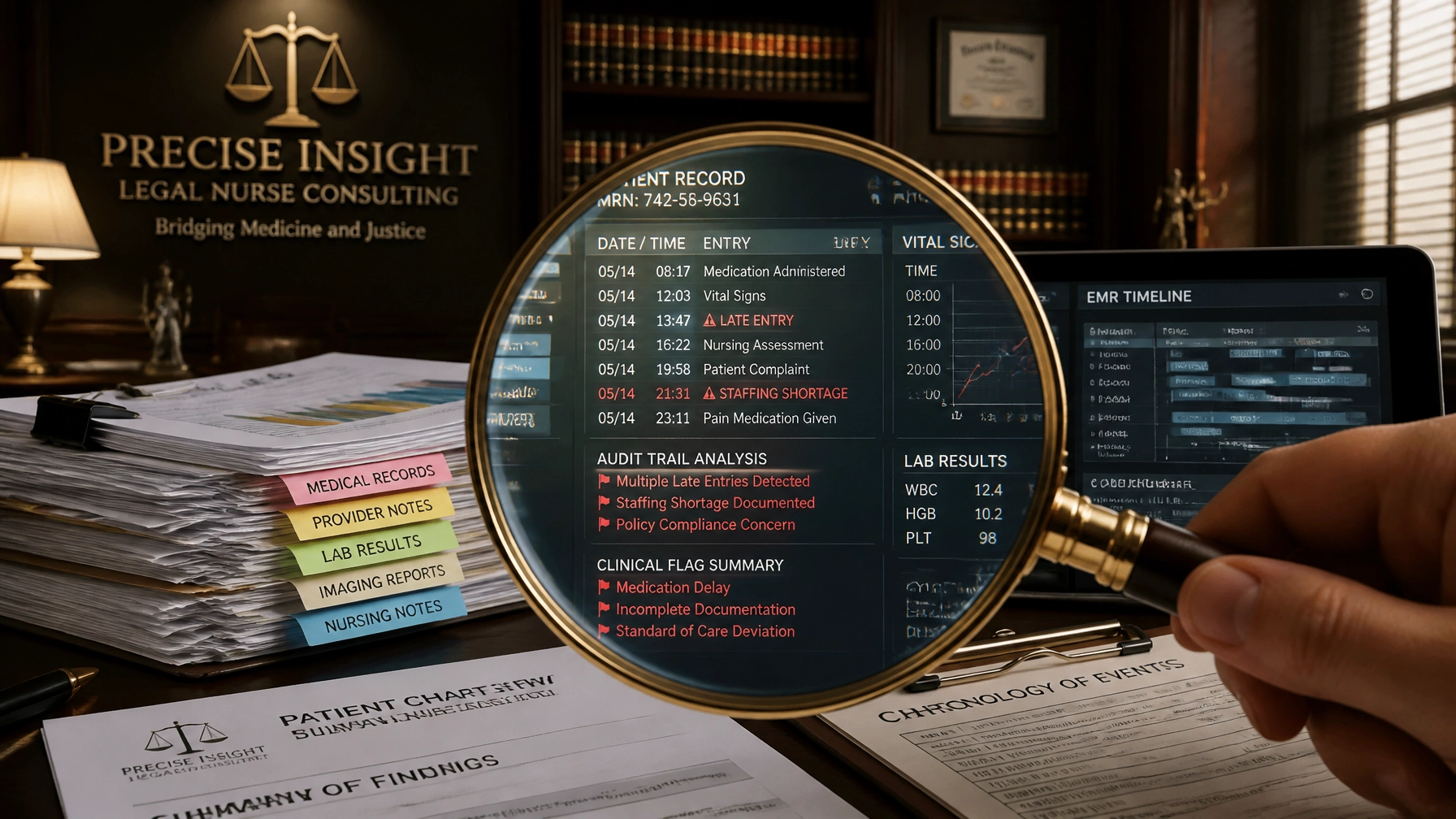
A legal nurse consultant can organize the records into a chronology, identify contradictions and missing documentation, and flag clinical questions for attorney review and expert evaluation. That early analysis helps you focus discovery: Which policy applies? Which staff members need to be deposed? When did the facility have notice? What evidence supports or weakens causation?
A clear chronology can also make the medical story easier to communicate. See how medical chronologies can work with trial graphics.

The earlier you identify the key questions, the better positioned you are to investigate the case, evaluate its strengths and weaknesses, and match the issues with qualified experts. OnPoint Legal Nurse Consulting has supported attorneys in bridging medicine and law since 1995, with record review, case merit assessment, and litigation support.
If you are reviewing a nursing home pressure injury claim, contact OnPoint to discuss medical record analysis and the next steps for your case.