
Medical records are supposed to document patient care. In a medical malpractice case, they also become evidence. When those records are altered, backdated, or fabricated, the issue extends beyond poor documentation. It strikes at the credibility of the defense.
A skilled legal nurse consultant knows how to find the difference between a legitimate correction and a manufactured narrative. The clues appear in timestamps, audit trails, handwriting, ink, forms, missing pages, copied entries, and clinical inconsistencies that do not withstand scrutiny.
That is where a qualified legal nurse consulting firm gives plaintiffs’ attorneys a decisive advantage.
Record Tampering Takes Several Forms
Record falsification does not always look dramatic. Sometimes it involves a completely new note. Other times, it is a subtle change to one vital sign, one medication entry, or one assessment.
Common forms include:
- Altered entries: Existing information is changed after the fact.
- Backdated entries: A note is entered later but made to appear as though it was written during the original patient encounter.
- Fabricated entries: A note, assessment, intervention, or physician notification is documented even though the event never occurred.
- Deleted or overwritten information: Original entries disappear or are replaced.
- Changed vital signs: Abnormal readings are modified to appear normal or less concerning.
- Substituted pages: Pages are removed from a paper chart or replaced with revised versions.
- Late-created documentation: A provider creates a detailed account only after an adverse outcome, complaint, claim, or litigation hold.
Not every late entry proves misconduct. Clinicians sometimes document late because of emergencies, workload, or system limitations. The issue is whether the record clearly identifies the entry as late, preserves the original information, and accurately states when the care occurred.
A legal nurse consultant examines the entire documentation ecosystem: not just the polished chart produced during discovery.

How Legal Nurse Consultants Catch Altered and Backdated EHR Entries
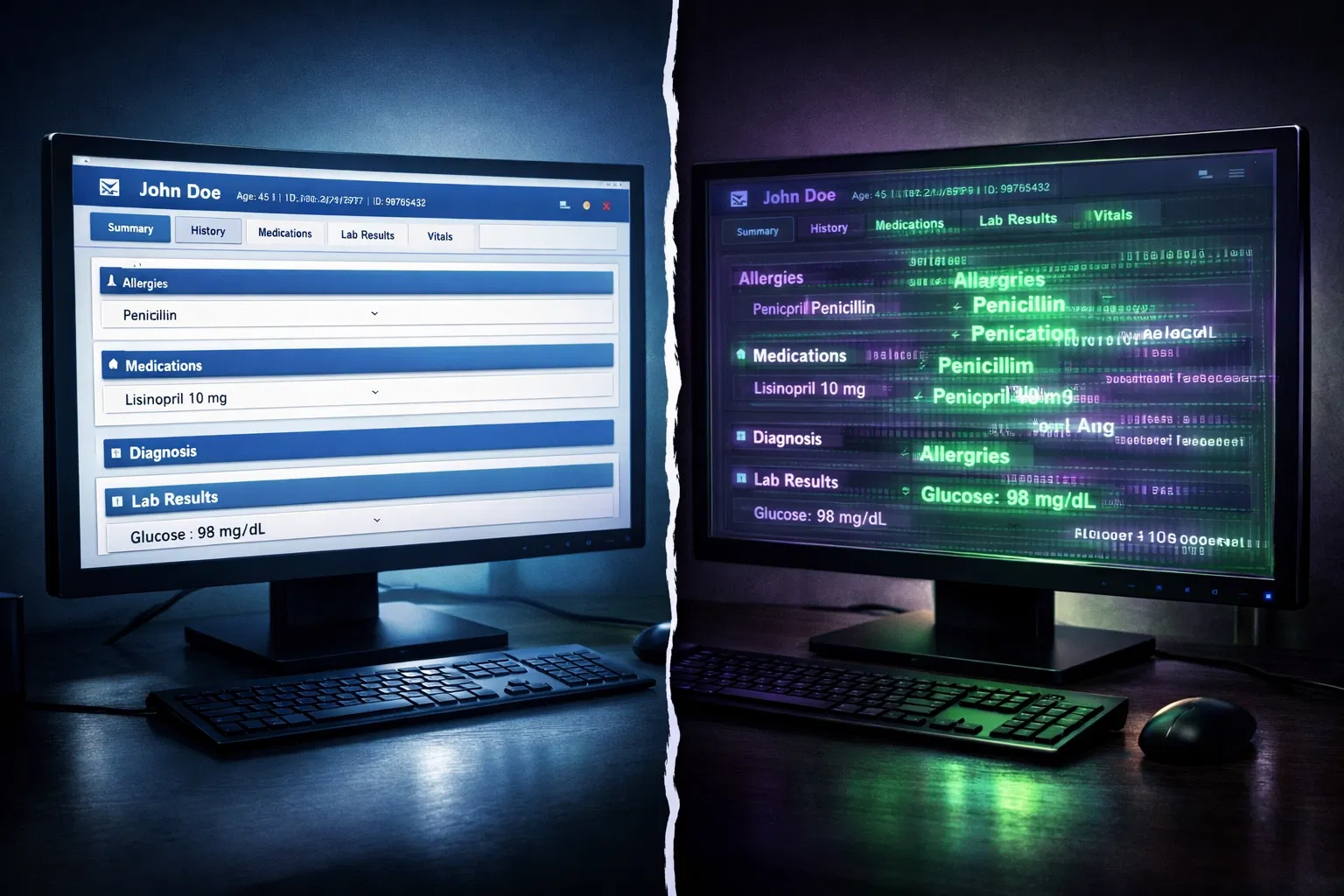
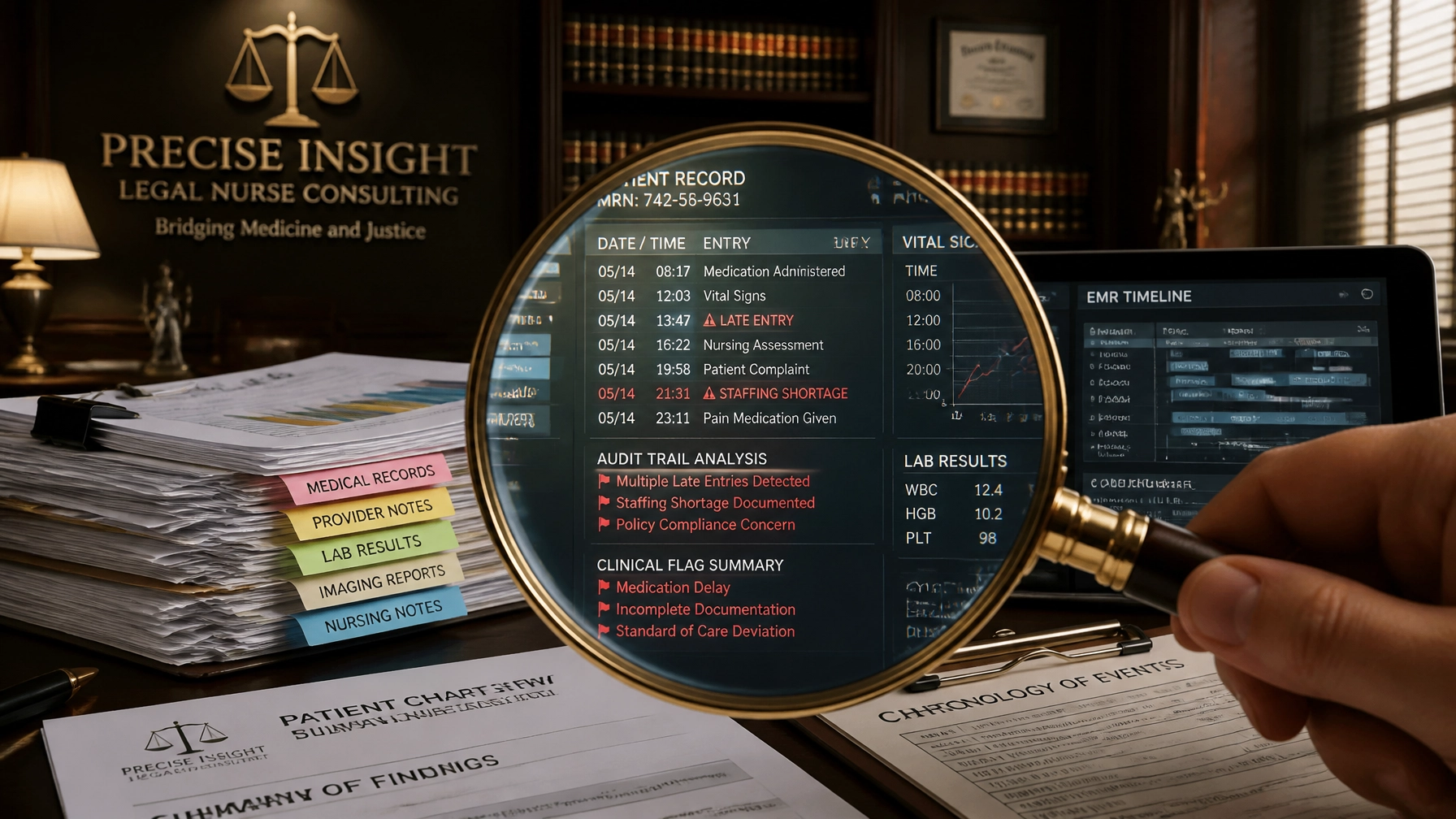
Electronic health records create a visible clinical chart. They also create a separate digital history showing how that chart was created and changed.
That history is the EHR audit trail.
An audit trail may identify:
- The user who accessed the record
- The date and time of access
- The date and time an entry was created
- The date and time an entry was modified
- The specific field, note, order, or flowsheet affected
- Whether information was added, edited, deleted, printed, copied, or exported
- The workstation, device, or location associated with the activity
- Original and revised values, depending on the system
The visible chart tells you what the record says. The audit trail can show when the record became what it says.
That distinction matters.
1. Comparing the documented time with the system time
A note may state that a nurse assessed the patient at 10:00 a.m. The audit trail may show that the note was not created until 8:45 p.m., after the patient deteriorated.
That timing does not automatically establish falsification. It does create a critical question:
Was this a clearly identified late entry, or was it presented as contemporaneous documentation?
A legal nurse consultant compares the stated event time, documentation time, signature time, and modification history. A chronology then separates two timelines:
- The clinical timeline: What supposedly happened to the patient.
- The documentation timeline: When each record entry was actually created or changed.
When those timelines diverge, the discrepancy becomes a deposition issue and potentially a spoliation or credibility issue.
2. Identifying post-event “cleanup”
The most revealing activity often occurs after the adverse event.
An LNC looks for clusters of activity after:
- A patient fall
- A code or rapid response
- A medication error
- A sentinel event
- A death
- A complaint from the family
- A request for records
- Notice of a potential claim
- An internal investigation
- Service of a preservation demand
For example, an audit trail may show that several nursing notes, vital signs, and physician notifications were added or modified in the hours after a patient suffered a catastrophic decline.
The question is straightforward: Why did the chart require extensive reconstruction after the outcome?
That question becomes difficult for a witness to answer when the audit trail shows the exact sequence of access, entry, editing, and signature activity.
3. Finding changed vital signs and flowsheet entries
Vital signs are a high-risk area because they directly affect the clinical story.
An LNC compares:
- Nursing flowsheets
- Monitor-generated data
- Manually entered vital signs
- Physician progress notes
- Rapid response documentation
- Medication administration records
- Laboratory values
- Respiratory therapy notes
- Transfer and discharge summaries
Consider a patient whose chart later describes stable oxygenation. The monitor record shows repeated oxygen desaturation, while the nursing flowsheet contains normal oxygen saturation values entered at regular intervals. The charting also states that the patient was resting comfortably, yet respiratory therapy records document escalating oxygen support.
Those contradictions demand investigation.
A legal nurse consultant does not treat one inconsistent number as proof of fraud. The consultant identifies the conflict, traces the source of each value, and determines whether the data was auto-populated, manually entered, edited, or copied forward.
4. Detecting copy-and-paste and cloned assessments
Electronic records make repetitive charting easy. They also make fabricated continuity easier to spot.
Red flags include:
- Identical assessments repeated across multiple shifts
- The same typo appearing in several supposedly independent notes
- Documentation describing a device, wound, or treatment that was not present
- Notes that use the same wording despite changing patient conditions
- A physical assessment that remains unchanged while labs and vital signs deteriorate
- A note describing an event before the related order or test occurred
A patient’s condition changes. The documentation should reflect those changes. When every assessment looks identical despite new symptoms, abnormal results, and escalating treatment, the record may show copied documentation rather than actual reassessment.
Paper Records Leave Physical Clues
Paper charts create different problems, but they also leave visible indicators.
A legal nurse consultant flags records for further forensic review when they contain:
- Different handwriting styles on the same form
- Ink that appears darker, newer, or inconsistent with surrounding entries
- Different pen pressure, letter formation, or spacing
- Numbers overwritten or crowded into a blank space
- Entries squeezed between existing lines
- Unusual abbreviations or terminology
- A signature that does not match the provider’s other signatures
- Forms printed on different paper stock
- Different margins, fonts, headers, or revision dates
- Page numbering that skips or repeats
- Missing continuation pages
- Staple holes or punch marks that do not align
- A form version that was not in use during the relevant treatment period
These signs do not independently prove tampering. They establish a reason to preserve the original records and involve a qualified forensic document examiner when appropriate.
That distinction matters. A legal nurse consultant provides clinical and documentation analysis. A forensic specialist may perform handwriting, ink, paper, printing, or alteration analysis. Together, they build a stronger evidentiary record.
When Charting Contradicts the Patient’s Clinical Condition
Clinical inconsistency is one of the strongest tools in medical record review.
A record may say:
- “Patient stable,” while vital signs show progressive hypotension.
- “No respiratory distress,” while oxygen requirements increase.
- “Pain controlled,” while the MAR shows repeated rescue medication.
- “Wound improving,” while measurements increase and drainage worsens.
- “Physician notified,” while no corresponding order, callback, or intervention appears.
- “Fall precautions in place,” while there is no documentation of implementation.
- “Patient educated,” while the patient’s documented condition prevents meaningful participation.
The legal nurse consultant cross-references the narrative against the underlying clinical data. This process often reveals that a favorable sentence in a progress note conflicts with the rest of the record.
That is the defense-killer: not an accusation unsupported by evidence, but a documented contradiction that makes the defense narrative impossible to maintain.

Why Tampering Evidence Matters at Deposition
A witness can explain a late entry. A witness has far less room to explain a pattern of post-event revisions that improves the defense narrative.
LNC analysis helps counsel ask precise questions:
- When did you first enter this note?
- Was the note entered during the patient encounter?
- If not, why does it appear under the earlier date and time?
- What information did you rely on when creating the late entry?
- Did you review another person’s note before documenting?
- Did you change the vital sign after the patient deteriorated?
- Who else accessed the record?
- Why were multiple entries modified after the family requested records?
- Where is the original version?
- Why does this note contradict the monitor data?
- Why does the record identify an intervention that does not appear in the MAR?
The attorney is no longer asking general questions about memory. The attorney is walking the witness through a system-generated timeline.
That difference changes the deposition.
Why It Matters at Trial
Jurors understand the basic concept of changing a story after the fact. They also understand that a medical record should be accurate, complete, and timely.
A clear visual chronology can show:
- The patient’s condition worsened.
- Required assessments or interventions are missing.
- The adverse event occurred.
- Documentation activity increased afterward.
- Notes or vital signs were modified.
- The revised chart now supports the defense position.
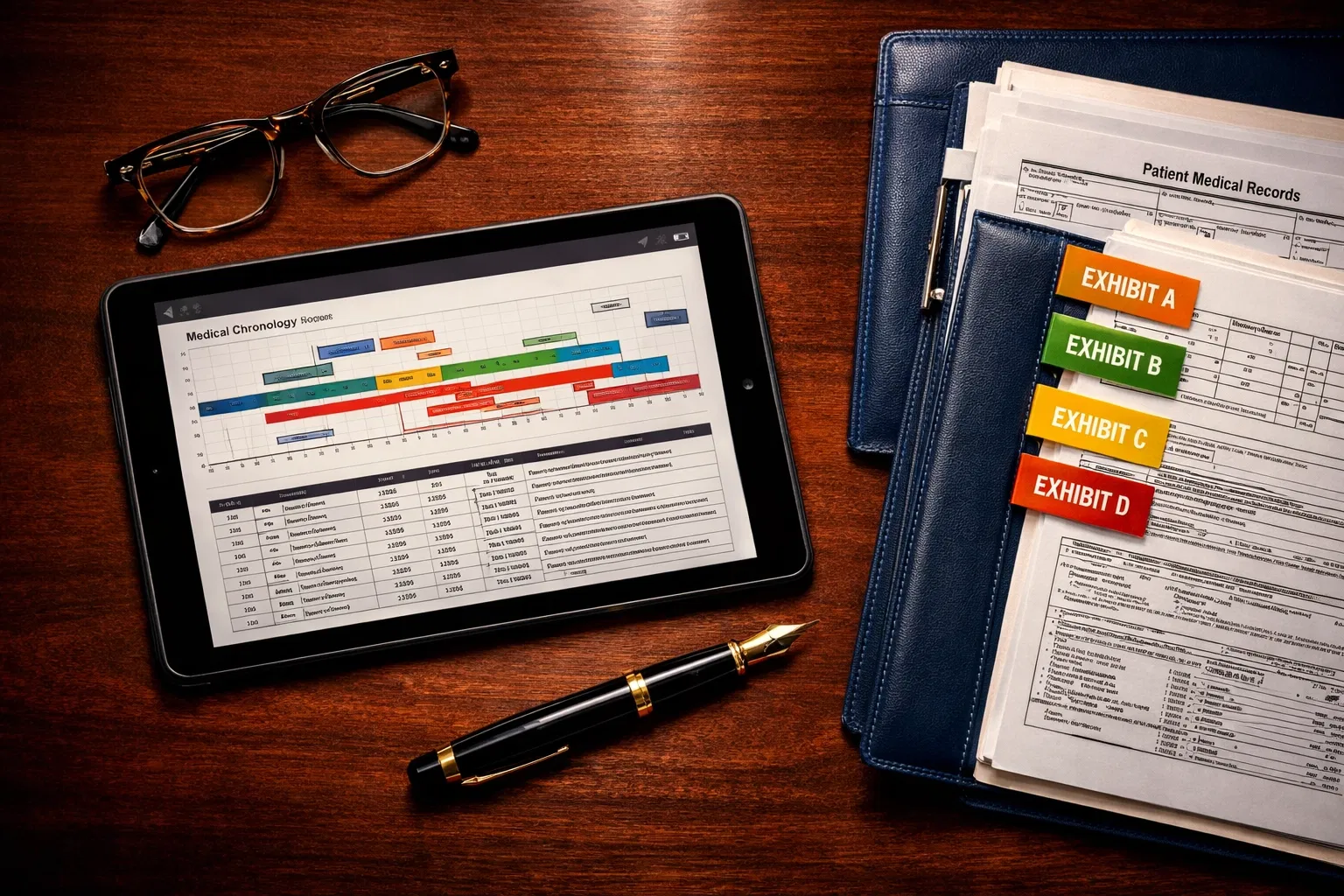
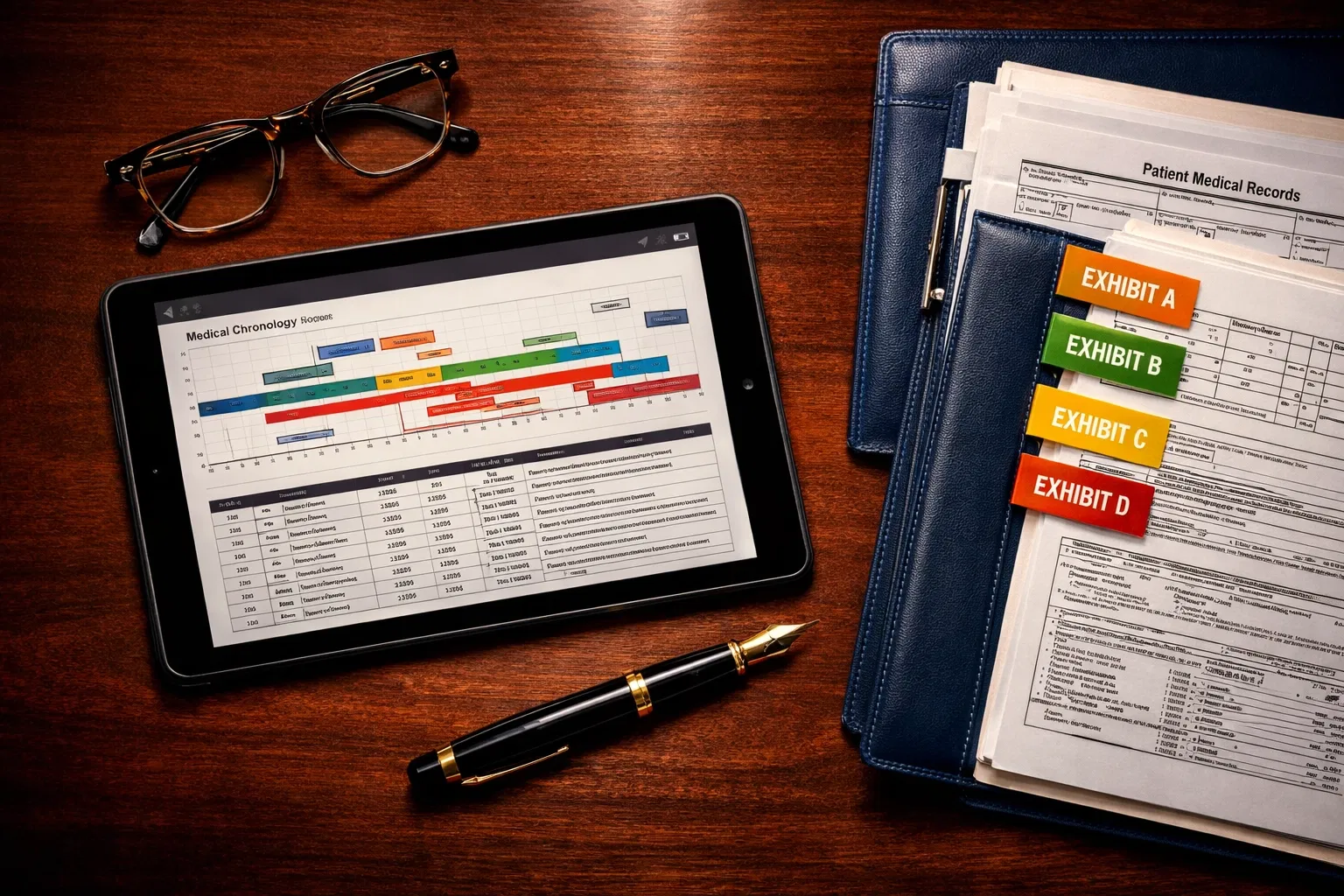
The evidence becomes easier to understand when presented through a source-linked timeline, audit-trail exhibit, or chart comparison. OnPoint’s guidance on integrating medical chronologies with trial graphics explains how complex records become a coherent visual story.
A credibility problem can become a liability problem when the defense cannot explain why its own records changed.
What Plaintiffs’ Attorneys Should Request Immediately
If record tampering is suspected, request and preserve more than a standard PDF chart.
Request:
- The complete certified medical record
- Native EHR exports when available
- The full audit trail or audit log
- Metadata associated with relevant notes and orders
- Original and amended versions
- Monitor-generated vital signs
- Nursing flowsheets
- Medication administration records
- Downtime records
- Code and rapid response records
- Staffing and assignment records
- Facility documentation policies
- Record-retention and amendment policies
- Prior copies obtained by the patient or family
- Internal incident reports, subject to applicable discovery rules
- Records from connected systems and specialty departments
Do not wait until the eve of trial. Audit data can be difficult to obtain, system-specific, and vulnerable to retention limits.
Engage a legal nurse consulting service early to organize the record, identify the gaps, compare versions, and prepare targeted requests before the evidence disappears into the weeds.
Partner With a Legal Nurse Consulting Firm Before the Story Changes
You do not need to review every page alone. You need to know which pages matter, what is missing, and whether the record reflects care as it happened: or a later version of events.
OnPoint Legal Nurse Consulting brings more than 25 years of experience bridging medicine and law. Our team supports medical malpractice, nursing malpractice, personal injury, wrongful death, nursing home, wound care, and workers’ compensation cases nationwide.
If you are searching for legal nurse consultants near me, location is only one factor. The right partner provides clinically current insight, structured medical-legal consulting, and actionable analysis wherever your case is filed.
Submit your case to OnPoint for confidential, structured support. When the chart does not add up, find out why before the defense turns a questionable record into its version of the truth.